
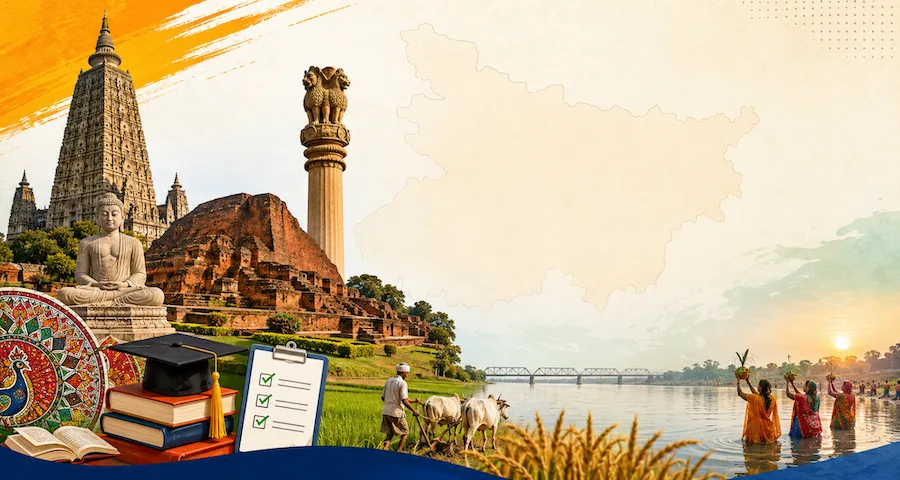
बिहारी ज्ञान Bihari Gyan — Complete Bihar GK Guide
Everything you need to know about Bihar’s history, geography, culture, and economy — written for students, exam aspirants (BPSC, SSC, Bihar Police), and anyone curious about the land of Buddha, Mahavira, and the world’s first republic.
We publish free study notes in Hindi and English for BPSC, SSC, Bihar Police, banking and other government exams — 316 guides across 10 subjects, no signup and nothing paid. This Bihar GK guide is one of them. Browse the full Study Library →
ज़िले
जनसंख्या
राज्य गठन
क्षेत्रफल
Bihari Gyan means the deep, lived knowledge of Bihar — its 2,500-year-old history, its rivers and rice fields, its festivals and freedom fighters, its heroes who built the world’s first republic at Vaishali long before Athens. This guide is designed for two kinds of readers: students preparing for BPSC, SSC, Bihar Police, and other competitive exams, and curious minds who want to understand why Bihar matters. Every fact below has been verified against standard reference works and is exam-relevant.
बिहारी ज्ञान का अर्थ है बिहार की गहरी और प्रामाणिक जानकारी — इसका 2,500 साल पुराना इतिहास, इसकी नदियाँ और खेत, इसके त्योहार और स्वतंत्रता सेनानी, और वे महान लोग जिन्होंने एथेंस से भी पहले वैशाली में दुनिया का पहला गणतंत्र बनाया। यह गाइड BPSC, SSC, बिहार पुलिस और अन्य प्रतियोगी परीक्षाओं की तैयारी कर रहे विद्यार्थियों के लिए है।
What This Bihari Gyan Guide Covers — क्या-क्या मिलेगा
History of Bihar — बिहार का इतिहास
Bihar is arguably the most historically significant state in India. The very name comes from vihara — the Sanskrit word for a Buddhist monastery — because the region was once dotted with hundreds of them. For over a thousand years, this land was the political, intellectual, and spiritual capital of the Indian subcontinent.
Ancient Bihar — The Birthplace of Empires
The Magadha empire, centered in modern Patna (ancient Pataliputra), was the cradle of Indian civilization’s first imperial state. Three of the most powerful dynasties in Indian history rose from this soil:
- Haryanka Dynasty (c. 600–413 BCE) — Bimbisara and Ajatashatru built Magadha into a regional power.
- Maurya Dynasty (322–185 BCE) — Founded by Chandragupta Maurya with help from Chanakya. His grandson Ashoka the Great ruled almost the entire subcontinent from Pataliputra.
- Gupta Dynasty (c. 320–550 CE) — Often called India’s “Golden Age,” producing astronomers like Aryabhata, mathematicians, and the foundations of classical Sanskrit literature.
Vaishali, in modern Bihar, is recognized as the world’s first republic (Gana-Sangha), established around 600 BCE — centuries before classical Athens. Both Gautama Buddha and Mahavira spent significant time here.
Medieval and Modern Bihar
The Pala dynasty (8th–12th century) made Bihar the center of Buddhist learning, founding Vikramshila and reviving Nalanda — the world’s first residential university, which had over 10,000 students at its peak. Bihar later came under the Delhi Sultanate, then the Mughals, and finally the British. Sher Shah Suri, born in Sasaram (Bihar), built the Grand Trunk Road and introduced the rupee — the basis of modern Indian currency.
In the freedom struggle, Bihar produced giants: Mahatma Gandhi launched his first satyagraha at Champaran (1917), Dr. Rajendra Prasad became independent India’s first President, and Jayaprakash Narayan (“JP”) led the movement that ended Emergency rule in 1977.
Geography of Bihar — बिहार का भूगोल
Bihar lies in eastern India, a fertile land carved by the Ganga river and its tributaries. The state is divided naturally by the Ganga into two parts: North Bihar and South Bihar. North Bihar is dominated by Himalayan-fed rivers (often causing floods); South Bihar is rocky, with the Chota Nagpur plateau on its southern fringe.
| Item | Detail |
|---|---|
| Capital | Patna (Pataliputra) |
| Districts | 38 |
| Area | 94,163 km² (12th in India) |
| Population | ~12.7 crore (3rd most populous state) |
| Major rivers | Ganga, Kosi, Gandak, Sone, Ghaghara, Bagmati, Falgu |
| Highest peak | Someshwar Hills (West Champaran) |
| Climate | Subtropical; hot summers, monsoon, mild winters |
| Major crops | Rice, wheat, maize, sugarcane, makhana, litchi |
The Kosi river is famously called “Bihar ka Shok” (Sorrow of Bihar) because it changes course frequently and causes massive floods. Bihar produces about 85% of India’s makhana (fox nut), mostly from Mithila region, and is also the largest producer of litchi.
Culture, Language & Festivals — संस्कृति और त्योहार
Bihar’s cultural identity is shaped by three major language traditions: Bhojpuri (western Bihar), Magahi (central, around Patna and Gaya), and Maithili (north Bihar, Mithila region — an officially recognized language in the 8th Schedule of the Constitution).
Festivals
- Chhath Puja — The most iconic Bihari festival, dedicated to the Sun god (Surya) and Chhathi Maiya. Celebrated over four days in October–November.
- Sama-Chakeva — A unique Mithila festival celebrating brother-sister bond.
- Madhushravani — Newlywed Maithil women’s festival in Sawan (July–August).
- Sonepur Mela — Asia’s largest cattle fair, held annually in Saran district.
- Rajgir Mahotsav — Cultural festival in the historic city of Rajgir.
Art & Heritage
Madhubani painting (also called Mithila painting) is Bihar’s globally recognized art form, traditionally done by women on walls and floors using natural pigments. It received GI tag (Geographical Indication) status in 2007. Other Bihar GI products include Bhagalpuri silk, Magahi paan, Shahi Litchi, and Katarni rice.
Famous Personalities from Bihar — प्रसिद्ध विभूतियाँ
| Name | Known For |
|---|---|
| Gautama Buddha | Attained enlightenment at Bodh Gaya (Bihar) |
| Mahavira | 24th Tirthankara of Jainism, born in Vaishali |
| Chandragupta Maurya | Founder of Maurya empire from Pataliputra |
| Ashoka the Great | Greatest Mauryan emperor, ruled from Pataliputra |
| Chanakya (Kautilya) | Author of Arthashastra, advisor to Chandragupta |
| Aryabhata | Mathematician/astronomer who calculated π and proposed earth’s rotation |
| Sher Shah Suri | Built the Grand Trunk Road, introduced the rupee |
| Dr. Rajendra Prasad | India’s first President; from Siwan, Bihar |
| Jayaprakash Narayan | “Lok Nayak”; led the JP Movement |
| Dr. APJ Abdul Kalam | India’s 11th President — he wasn’t from Bihar but is widely studied |
Quick Bihari Gyan Quiz — छोटा क्विज़
Test what you’ve learned. 5 questions, no signup, instant feedback. Great for a quick BPSC/SSC warm-up.
Enjoyed the quiz? और अभ्यास चाहिए?
We have full MCQ sets and short revision summaries for banking and government exams — all free, in Hindi and English.
Practice More MCQs →Why Bihari Gyan Matters for Competitive Exams
If you’re preparing for BPSC (Bihar Public Service Commission), Bihar-specific GK is not optional — it’s a major scoring section. The same is true for Bihar Police constable and SI exams, Bihar Daroga, Bihar TET/STET, and SSC regional posting questions. National-level exams like UPSC, SSC CGL, and Banking PO regularly include questions on Bihar’s history (Magadha, Maurya, Gupta), Vaishali republic, and freedom struggle figures from Bihar.
Beyond exams, this knowledge helps you understand the depth of your own state’s contribution to Indian civilization. Bihar isn’t a backwater that needs catching up — it was once the capital of the largest empire on earth. Knowing this changes how you carry yourself.
What to study next आगे क्या पढ़ें
Bihar GK is one paper. If you’re preparing for BPSC, Bihar Police or a banking exam, this is the order we’d suggest — every guide below is free:
Frequently Asked Questions — अक्सर पूछे जाने वाले सवाल
“Bihari Gyan” (बिहारी ज्ञान) means knowledge about Bihar — its history, geography, culture, economy, and the famous personalities who shaped Indian civilization from this region. It’s commonly used as a study category for BPSC, SSC, and Bihar Police competitive exams.
Bihar was carved out of Bengal Presidency on 22 March 1912 — that’s why Bihar Diwas is celebrated every year on 22 March. Jharkhand was separated from Bihar much later, on 15 November 2000.
Gautama Buddha attained enlightenment under the Bodhi tree at Bodh Gaya in Bihar. Mahavira, the 24th Tirthankara of Jainism, was born in Vaishali (also Bihar) and attained nirvana at Pavapuri (Nalanda district, Bihar). Both major non-Vedic Indian religions trace their origin to this land.
The Kosi river is called Bihar’s Sorrow (“बिहार का शोक”) because it frequently changes its course and causes devastating floods in north Bihar. It originates in the Himalayas and joins the Ganga.
Bihar has 38 districts, organized into 9 administrative divisions. Patna is the capital and Patna district is the most populous.
No. National exams like UPSC Civil Services, SSC CGL, Banking PO, and Railway exams regularly ask questions on Magadha empire, Mauryan history, Vaishali republic, Buddhism’s origin, and freedom fighters from Bihar (Rajendra Prasad, JP Narayan, Anugrah Narayan Sinha). Bihar GK has national exam value.
Bihar is famous for being the birthplace of Buddhism and Jainism, the seat of ancient Magadha and Maurya empires, the Nalanda University (world’s first residential university), Madhubani painting, Chhath Puja, and producing 85% of India’s makhana. It’s also globally recognized for its contribution to Indian freedom struggle through Champaran Satyagraha (Gandhi’s first major movement in India).
Want more like this? और भी पढ़ें?
GyanDesk publishes free Hindi & English study guides for Bihar GK, current affairs, and competitive exams every week.
Explore More Free Resources →Continue learning on GyanDesk
Preparing for BPSC, SSC, Bihar Police or a banking exam? These free resources go with this guide:
- Latest Government Jobs — current openings, notifications and last dates
- Exam Guides & MCQs — practice questions and short revision summaries
- Indian Economy & Financial System — a core GK topic in almost every government exam
- Top Study Tips for Competitive Exams — how to build a study routine that actually sticks
- Banking Awareness — essential for IBPS, SBI and other banking exams
Browse the full Study Library → 316 free study notes across 10 subjects, no signup needed.